
The end of payment authorisation: why AI agents need intelligent contracts

Article one of two
From a payment instruction to a commercial agreement
For more than sixty years, electronic commerce has been organised around a deceptively simple question: should this payment be authorised? Card networks became extraordinarily effective at answering it; they connect issuers, acquirers, merchants and consumers, transmit standardised messages, apply fraud controls and allocate disputes through a common rulebook. The model has helped convert a fragmented collection of local payment practices into a globally recognised method of paying. That architecture remains highly valuable.
The strength of both businesses lies not merely in technology, but in their standards, acceptance, brand recognition, bank relationships and established consumer protections. Artificial intelligence (AI) does not make those achievements irrelevant. It changes the commercial problem that infrastructure must solve. A human buyer usually chooses a product (often based on brand), accepts the merchant’s terms and then presents a payment credential. An AI agent may instead search thousands of suppliers, compare contractual conditions, test spending limits, assess delivery risk, select insurance, calculate tax, negotiates when payment should be released and is not biased by clever brand positioning. In that environment, payment authorisation remains necessary, but it becomes one clause within a much richer agreement. The commercial object is therefore beginning to shift. In the card era, the central object was an authorised payment message governed by a network rulebook. In agentic commerce, the central object may become an intelligent contract: a machine-readable agreement that records who the parties are, what each agent is authorised to do, what is being purchased, which risks each party accepts, how tax is treated, what evidence is required and when value should pass.
Why cards became such effective infrastructure
The continued relevance of card networks needs to be understood before considering what may sit alongside them. Their success came from reducing complexity, hence, rather than asking every buyer and merchant to negotiate payment, fraud and dispute terms independently, the networks supplied a common contractual and operational framework. Issuing banks assessed customers and provided credit, acquirers connected merchants, networks routed authorisation and settlement messages, and chargeback processes allocated losses when transactions were disputed. This standardisation produced enormous economies of scale and massive profits.
Profit margin comparison: Visa & Mastercard vs. S&P 500 average
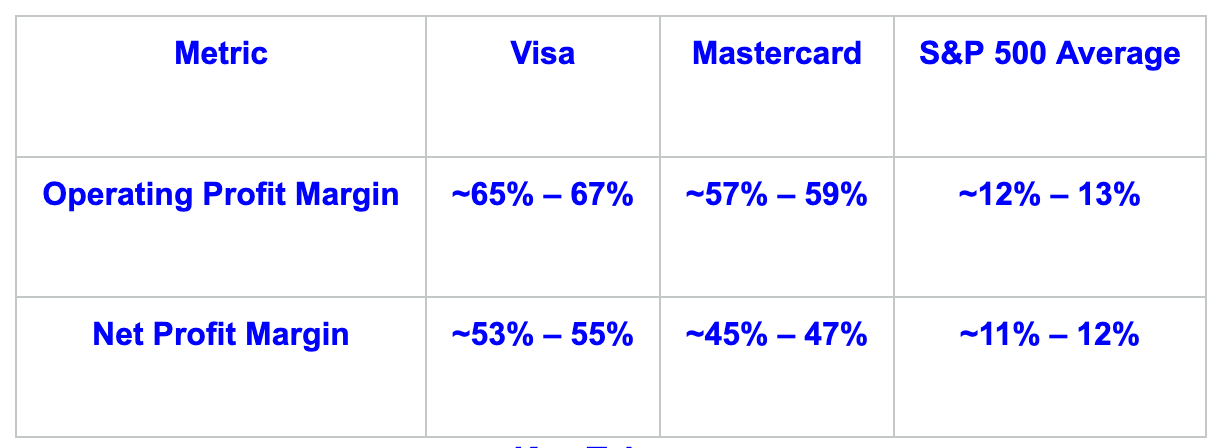
Source: Macrotrends Mastercard Profit Margin History, YCharts S&P 500 Profit Margin Data and Macrotrends Visa Profit Margin History.
Once the networks, rules and acceptance base were established, additional transactions could be processed at relatively low marginal cost. It also gave consumers confidence that a familiar payment method would work across merchants and countries. For routine human purchases, that convenience is difficult to displace. The card model is nevertheless optimised for credential authorisation rather than full commercial negotiation. Its messages typically confirm that a payment instrument is valid and that an issuer is prepared to approve a transaction. They do not ordinarily contain a bespoke allocation of product liability, insurance, tax treatment, delivery milestones, merchant solvency conditions or the legal authority of an autonomous software agent. Those matters sit in separate merchant systems, terms and conditions, invoices, insurance contracts and regulatory processes. So, although this separation was rational when bespoke contracting was expensive and slow, it becomes less inevitable when two software agents can exchange structured terms in milliseconds. The question is not whether cards can process an agent-initiated purchase: they already can. The question is whether payment authorisation should remain the primary organising object when software can negotiate the wider commercial relationship at comparable speed.
Card networks are already adapting
Any credible analysis must recognise that Visa and Mastercard are not passive incumbents. Visa Intelligent Commerce provides tools for agent-specific payment tokens, authentication, transaction controls and commerce signal. Visa has also expanded partnerships intended to connect AI agents, merchants and its payment infrastructure, including work with OpenAI and tools that help merchants make catalogues discoverable to agents. Visa’s research suggests that consumers want transparency and the ability to override agents, whilst many businesses are open to AI-to-AI negotiation. Mastercard Agent Pay takes a similar approach, using tokenised credentials and what it calls “verifiable intent” to establish that a consumer authorised an agent to transact. Mastercard and Santander completed a live European payment executed by an AI agent in March 2026, whilst later deployments with Worldline and ING demonstrated production-oriented agentic payments. These initiatives matter because they show that card networks can evolve - they can give agents-controlled credentials, preserve consumer permissions and use existing acceptance infrastructure. For many purchases, that may prove sufficient, yet the initiatives also reveal the boundary between an agentic payment and an intelligent contract. A token can prove that an agent may pay. It does not, by itself, determine whether the merchant will remain solvent until a future service is delivered, whether funds should vest in stages, who bears non-performance risk, or whether insurance should be priced dynamically. The likely future is therefore layered rather than binary. Existing networks may continue to provide settlement, fraud intelligence and global acceptance. Intelligent contracts may sit above them, coordinating negotiation, evidence, risk and performance. Cards, instant bank payments, tokenised deposits and regulated stablecoins could become alternative settlement methods selected by the contract rather than competing to be the entire commercial architecture.
Verify, validate and vest
An intelligent contract requires a clearer separation of functions than the compressed authorise, clear and settle sequence familiar from card payments. One useful framework is “verify, validate and vest”:
· verify - establishes identity and provenance. It asks which agent is participating, which person or organisation stands behind it and what assurance supports that identity. Modern digital identity practice already separates identity proofing, authentication and federation. The latest NIST Digital Identity Guidelines provide risk-based assurance models rather than if every transaction requires the same level of scrutiny. A low-value grocery purchase may need only a wallet-bound mandate and device authentication. A property purchase or large corporate payment may require enhanced identity evidence, professional review and dual control.
· validate - concludes whether the agent has authority to agree the proposed terms. A valid identity does not prove a valid mandate. The agent may be permitted to spend £100 on travel but not £10,000, to purchase equipment but not securities, or to transact only with approved counterparties. Validation also checks whether contractual terms, tax, insurance and settlement assets comply with the principal’s policy and applicable regulation.
· vest - determines when value and commercial risk pass. Immediate vesting may be appropriate for a drink handed over at a shop. A household appliance may require payment to vest after delivery. A holiday or construction contract may release funds in stages as defined milestones are verified. The wallet need not physically hold an asset in every model: it can instead control the authority or key required to release value from a safeguarded account, tokenised deposit, stablecoin address or other settlement mechanism.
Keeping these stages distinct creates a more precise audit trail. A transaction may fail because identity was insufficient, because the agent lacked authority, because a contractual condition was unacceptable or because evidence of performance did not arrive. That distinction is important for insurers, auditors and courts. It also allows a system to reject an unauthorised transaction before funds move rather than relying primarily on recovery after the event.
Identity, mandate and proof without unnecessary disclosure
The development of agentic commerce will increase demand for financial and identity verification. It does not follow that AI agents should receive unrestricted access to bank accounts or confidential corporate records. In many cases, the commercial question can be answered through a limited attestation. A buyer’s bank might confirm that sufficient funds are available for a £25,000 purchase without revealing the complete balance or transaction history. An accounting platform might confirm that a merchant’s liquidity exceeds an agreed threshold without disclosing its full accounts. An identity provider might confirm that a director has authority to bind a company without exposing unrelated personal data. Plaid’s work on intelligent finance demonstrates how permissioned financial data can be connected to AI systems to provide real-time, personalised analysis. Plaid’s integrations show the practical possibility of allowing a customer to connect accounts to an AI service. For agentic commerce, the more significant development may be the move from raw data sharing to purpose-limited proofs. The agent receives the answer needed to proceed, not every underlying data point used to produce it. This distinction may become central to trust. A counterparty could prove solvency, funds, insurance or regulatory status through a signed assertion with a defined expiry time. The receiving agent could verify the issuer and apply the result to its mandate. Cryptographic techniques, including zero-knowledge proofs, may eventually allow more of these conditions to be demonstrated without disclosing sensitive values. However, governance will matter as much as cryptography. Someone must define the test, accept liability for an inaccurate assertion and specify how quickly the proof becomes stale.
Legal enforceability and the limits of automation
An intelligent contract must be legally meaningful, not merely executable code. The Law Commission’s work on smart legal contracts has concluded that the existing law of England and Wales can generally accommodate smart legal contracts and that such arrangements can create binding obligations. That is an important foundation, but it does not mean every machine-generated clause will be enforceable or appropriate. The contract must identify governing law, jurisdiction, the principals represented by the agents and the scope of each mandate. It must also accommodate statutory protections that cannot simply be contracted away. Consumer cancellation rights, unfair terms rules, product safety duties, sanctions obligations and anti-money laundering requirements continue to apply regardless of the technology used to settle. Code can also execute a result that the law later challenges. Funds might be released because a sensor incorrectly reported delivery, because an agent misinterpreted an instruction or because a party supplied fraudulent evidence. A robust architecture therefore needs mechanisms for suspension, correction, appeal and, where necessary, human or judicial intervention. The value of automation lies in making routine performance faster and more explicit, not in pretending that commercial disputes disappear. The UK corporate offence of failure to prevent fraud (which came into force on 1st September 2025), illustrates why governance cannot be reduced to a technical check. Machine-readable mandates, identity checks and audit trails could support reasonable prevention procedures, but organisations still need risk assessment, responsibility, monitoring, training and documented controls.
Settlement assets and compliance remain part of the design
An intelligent contract may permit settlement through cards, bank transfers, tokenised deposits, regulated stablecoins or other agreed assets. That flexibility can improve speed and reach, but each asset carries different risks: commercial bank money depends on the bank; a stablecoin introduces issuer, reserve, redemption and depegging risk; a tokenised deposit may operate only within a particular banking network; and cross-border assets may create foreign exchange, tax and sanctions questions. The contract must therefore state what constitutes valid consideration, which exchange rate or valuation source applies, who bears conversion risk and what happens if the chosen asset cannot be redeemed or transferred. Flexibility without explicit allocation of these risks would merely move uncertainty from the payment rail into the contract. Financial crime controls also remain essential. The FATF’s March 2026 report on stablecoins and un-hosted wallets highlights the risks associated with peer-to-peer transfers where regulated intermediaries may be absent. Intelligent contracts could strengthen traceability by recording identity, authority and purpose, but the use of software does not automatically satisfy anti-money laundering or sanctions requirements. The model must determine when screening occurs, who is responsible, how suspicious transactions are paused and how privacy is balanced with lawful disclosure.
From payment networks to commercial networks
The larger economic possibility is not simply a cheaper payment - it is the emergence of commercial networks that co-ordinate contracting and performance as well as settlement. The payment message becomes one component of a structured record containing the parties, goods or services, authority, tax, insurance, performance conditions and evidence. That record could improve decisions before a transaction is completed. A merchant agent could refuse a payment asset it considers risky, require proof of insurance or request a deposit. A customer agent could demand staged settlement where delivery is deferred. An insurer could price cover from the same machine-readable terms and later assess a claim against the verify, validate and vest audit trail. A tax authority could receive a consistent statement of taxable consideration even when settlement occurs in a non-local asset. The Bank for International Settlements has already examined how AI agents could support liquidity and cash management in payment systems. The Bank of England has also referred publicly to the need for future retail infrastructure to support payments made by AI agents. These developments do not prove that intelligent contracts will become the dominant model. They show that policymakers and infrastructure providers are beginning to prepare for machine-initiated financial activity. The transition will depend on interoperability. Agents need common formats for identity assertions, mandates, contract clauses, evidence, revocation and dispute messages. Banks, merchants, insurers and regulators must be able to interpret those records consistently. Without shared standards, intelligent contracts risk producing fragmented networks that recreate the silos they are intended to reduce.
A change in architecture, not an overnight replacement
The strongest conclusion is therefore more measured than the claim that AI agents will replace Visa and Mastercard. Card networks are likely to remain important because they offer ubiquity, familiar protections and trusted settlement. They are also investing heavily to make their infrastructure usable by agents. What may change is their position within the commercial stack. Payment authorisation could become one service selected by an intelligent contract rather than the organising principle of the entire transaction. The contract would determine who may act, what has been agreed, what evidence is required and when value should move. The rail would execute the payment chosen by those terms: that distinction matters. The card era industrialised the authorisation of human payments, but the agentic era may industrialise the negotiation and performance of commercial agreements. The opportunity is not to discard the infrastructure that already works, but to connect it to a richer architecture capable of carrying identity, authority, risk and contractual intent at machine speed.
Next week: from theory to commercial practice
This first article has examined why the commercial object may be shifting from a payment authorisation to an intelligent contract. The second article will test that proposition through practical examples: a low-value retail purchase, a dishwasher requiring delivery and installation, a prepaid holiday exposed to supplier failure and a business procurement contract involving inspection, insurance and staged settlement. It will also examine the harder questions. How can tax be calculated without turning every purchase into a regulatory reporting event? Who supplies reliable evidence that performance occurred? How should an AI agent’s mistake be allocated between the customer, software provider, merchant, bank and insurer? And could privacy-preserving financial attestations enable real-time counterparty assessment without creating a new system of commercial surveillance? The next question is no longer whether an AI agent can make a payment. It is whether commerce can verify performance before, during and after that payment, and whether the resulting system is more trusted than the one it seeks to extend.