

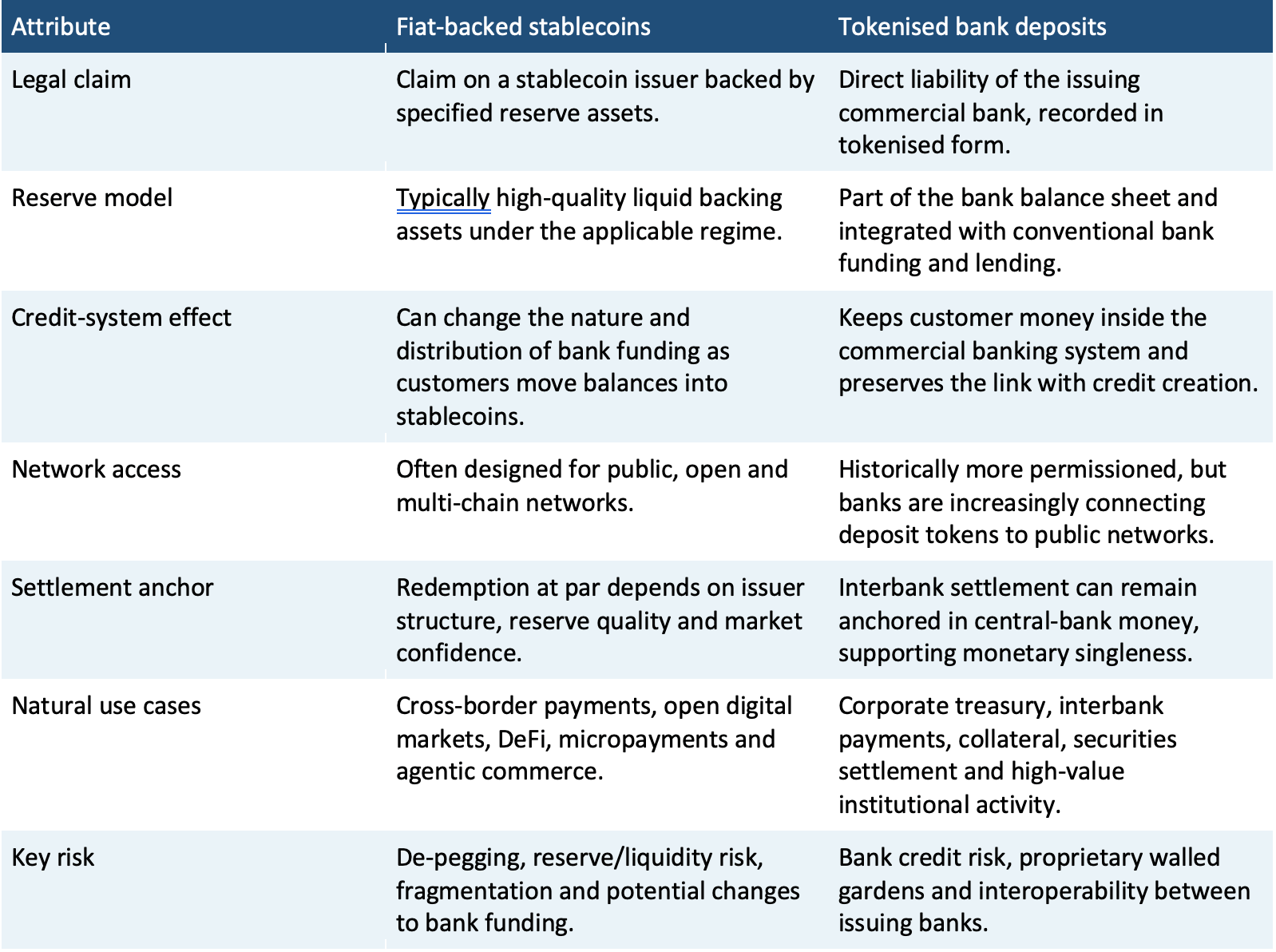
The debate over digital money is moving away from a binary choice between banks and crypto with the more consequential contest being now between two forms of programmable money: fiat-backed stablecoins and tokenised commercial-bank deposits. Both can move across digital ledgers around the clock, interact with smart contracts and settle transactions far faster than many legacy processes, yet they are economically and legally different. Stablecoins are typically backed by pools of highly liquid assets whilst a tokenised deposit remains a liability of a commercial bank, and so ought to have the same credit rating as the banks that issue them. That distinction determines who earns the economics, who bears the risk and how digital money interacts with the credit system. And certainly the Bank for International Settlements (BIS) sharpened this debate at Jackson Hole on 28 August 2026, with its argument being that the question is not simply which instrument is faster, but whether digital money preserves the “singleness of money” - i.e., the expectation that one GDP, CHF, Yen, Euro or US Dollar can be exchanged at par with another without users needing to inspect the pedigree of every payment instrument.
Stablecoins and tokenised deposits: similar technology, different economics
Source: Teamblockchain
The credit question is more subtle than, “Do stablecoins drain banks”?
One of the strongest arguments for tokenised deposits is that they keep digital money inside the regulated banking system. If customers shift large balances from deposits into stablecoins, individual banks can lose stable funding and may need to replace it with more expensive wholesale funding which can influence the availability and price of loans to households and businesses. The Bank of England takes this risk seriously enough to impose an initial £40 billion issuance guardrail on each systemic sterling stablecoin whilst banks adapt their funding models. But it is too simplistic to say every pound moved into a stablecoin disappears from the banking system. FDIC Chairman, Travis Hill, has noted that money used to acquire a stablecoin may ultimately remain as deposits somewhere in the banking system. The macroeconomic issue is therefore often the distribution, stability and cost of bank funding rather than its automatic disappearance. Certainly, that distinction matters: the policy challenge is to gain better payment infrastructure without unintentionally making productive credit more expensive.
Singleness: does every digital pound remain worth exactly one pound?
The BIS makes a deeper monetary point. Commercial-bank deposits issued by different banks remain interchangeable at par because the banking system ultimately settles obligations in central-bank money. Stablecoins can achieve strong par redemption arrangements, but separate coins may still trade at slightly different prices on secondary markets or across different blockchains, particularly during stress. That can fragment liquidity and require users to ask questions they do not ask when receiving ordinary bank money. Hence, this raises a deceptively simple question: if £1 at Barclays, HSBC or NatWest is treated as the same £1, should a digital economy accept a future in which users or AI agents must distinguish between multiple privately issued pounds? The answer will shape whether stablecoins become general-purpose money or remain specialised settlement instruments alongside tokenised bank deposits. Moreover, the old distinction between “stablecoins on public chains” and “banks on private ledgers” is already breaking down. JP Morgan’s Kinexys reports it has processed more than $3 trillion since inception and averages more than $5 billion of transactions a day with its dollar-denominated JPMD deposit token being available to institutional clients on Base, Coinbase’s public Ethereum Layer-2 network. The increasingly important question is therefore not whether the blockchain is public or private, but whose liability is travelling across it: a bank’s deposit or a stablecoin issuer’s token?
Project Agorá shows how bank money could become programmable
The BIS Project Agorá provides a glimpse of an alternative to fragmented proprietary bank tokens. In July 2026, twenty-eight financial institutions and central banks completed real-value transactions across Asia, Europe and North America using a prototype that represents both commercial-bank deposits and central-bank reserves on a shared programmable platform. The testing covered corporate payments, interbank transfers and payment-versus-payment transactions with average initiation-to-settlement time of around 80 seconds - despite the prototype not being fully integrated with existing RTGS and core-banking systems. And that matters because tokenised deposits only compete effectively with stablecoins if they become interoperable. A digital deposit that works only inside one bank’s network risks recreating the correspondent-banking silos that tokenisation is supposed to remove. Undoubtedly, artificial intelligence makes this competition much more urgent: human customers tolerate account-opening forms, payment screens, card authorisations and banking cut-off times. Autonomous software does not. An AI agent buying data, computing power or an API call needs money that is available 24/7, programmable, machine-readable and economical - even when the payment is measured in fractions of a cent.
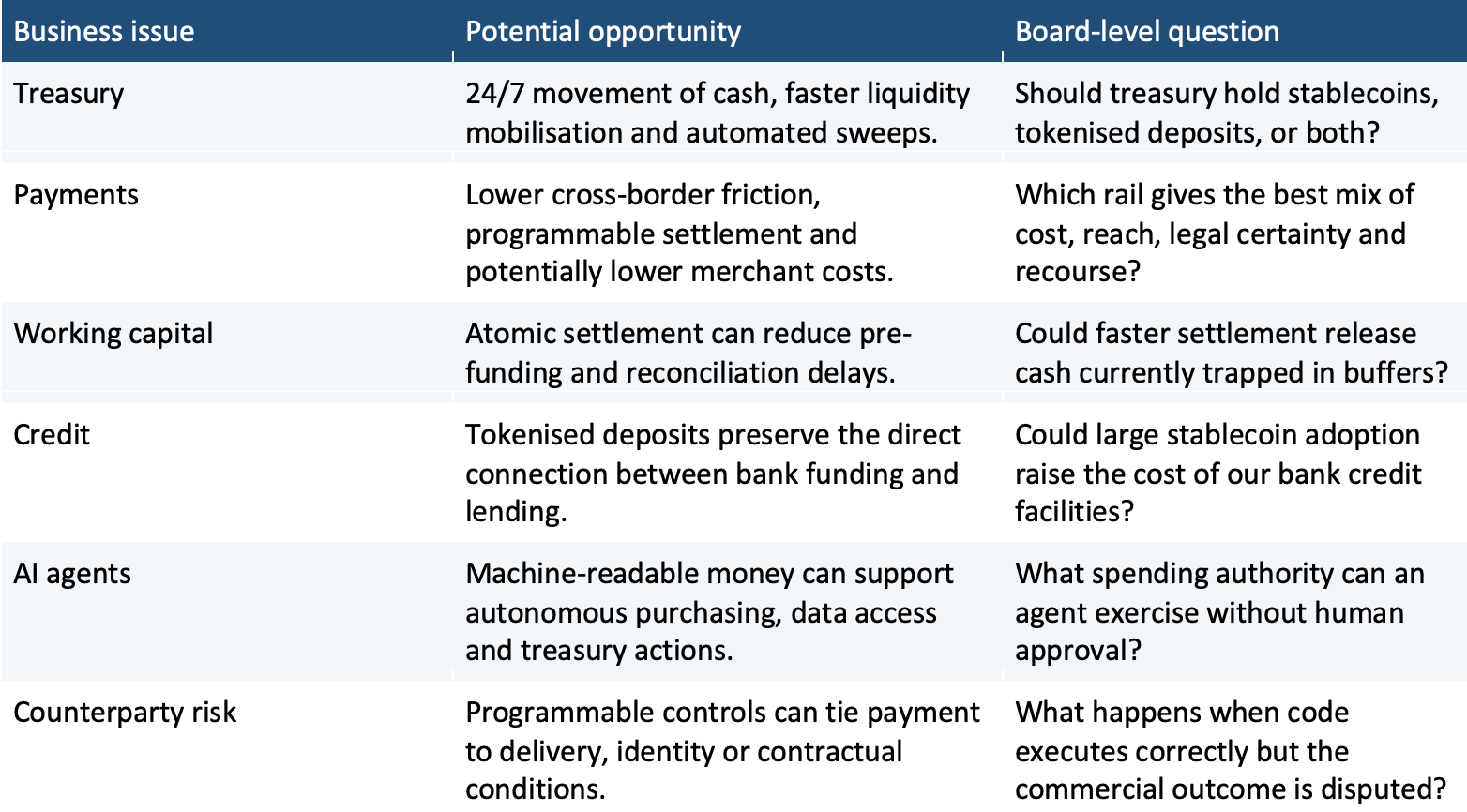
Coinbase reports that its x402 agentic payments protocol processed more than 160 million agentic payments in the year to June 2026. More recently, Amazon Bedrock AgentCore Payments integrated x402 and stablecoin wallets so developers can give AI agents budgets, compliance controls and audit trails whilst allowing them to purchase services automatically. This is an early demonstration of something strategically important: the next large wave of users of digital money may not be people at all. Stablecoins currently have a natural advantage for low-value machine-to-machine commerce because they are open, divisible and easy for software to integrate. However, a $0.01 API call and a $10 million corporate procurement transaction are not the same risk problem. High-value agents will need verified identity, delegated authority, sanctions controls, legal certainty, spending limits, dispute processes and evidence of who authorised what. Tokenised deposits may therefore become particularly attractive where AI agents operate inside regulated corporate treasury and banking relationships.
What this means for business
Source: Teamblockchain
Why the wider economy should care
This is not simply a technology choice for payment departments. Money performs two economic functions at once: it moves value whilst commercial-bank deposits also help fund lending to businesses and households. Hence, a successful stablecoin system could make the first function dramatically more efficient whilst changing the economics of the second. Moreover, the Bank of England’s steady-state regime illustrates the trade-off: systemic sterling stablecoins would hold 30% of backing assets as unremunerated central-bank deposits and up to 70% in short-term UK government debt. At scale, that could redirect some liquidity towards government securities and away from the funding profile banks use today. There exists also a geopolitical dimension: if the easiest programmable money for global businesses and AI agents is a US dollar stablecoin, firms in smaller economies may increasingly invoice, save or transact digitally in US dollars rather than domestic currencies. The result could be more efficient trade but weaker monetary sovereignty. Tokenised domestic bank deposits and interoperable central-bank settlement platforms are therefore not merely defensive banking projects; they may become part of the infrastructure through which countries keep their currencies relevant in a machine-driven economy.
Ultimately, the most likely outcome is co-existence. Stablecoins are well suited to open digital networks, cross-border commerce, DeFi and machine micropayments. Tokenised deposits are well suited to corporate liquidity, bank-integrated credit, high-value settlement and regulated capital markets. Shared platforms such as Project Agorá and public-network initiatives such as JPMD suggest the two models may increasingly interoperate rather than live in separate worlds. Yet, co-existence does not mean the result is economically neutral: the winning rails will influence where liquidity sits, who earns reserve income, how banks fund loans, which currencies dominate machine commerce and which institutions control the interfaces used by AI agents. The battle between stablecoins and tokenised deposits is therefore about far more than faster payments. It is a contest over who creates digital money, who captures its economics and how tomorrow’s credit is financed. As AI agents become economic actors in their own right, the decisive advantage may belong to whichever form of money machines can trust, understand and spend without waiting for humans.