
Tokenised treasuries, instant settlement and 24/7 markets: the future of capital markets has arrived

In May 2026, the tokenised US Treasuries sector hit an unprecedented $15.35 billion in value. Institutional demand for on-chain, yield-bearing dollar assets is rising despite inflation and macro-economic uncertainty, and reaching a record high. An experimental use of blockchain technology in traditional finance has become a major capital markets infrastructure breakthrough. In two years, tokenised US Treasuries increased tenfold, from under $1 billion in early 2024 to over $10 billion in January 2026. This accelerated expansion has attracted institutional investors worldwide, who are realising that tokenisation addresses fundamental inefficiencies in traditional fixed-income markets and opens up new opportunities for capital deployment and financial innovation. Furthermore, the implications extend beyond the digitisation of these instruments. Distributed ledger technology may improve, not replace, the foundational assets of global finance as tokenised treasuries bridge traditional finance and blockchain infrastructure. As large financial institutions accelerate tokenisation and legal frameworks evolve, these instruments will transform the digital capital markets.
Tokenised US Treasuries global market value
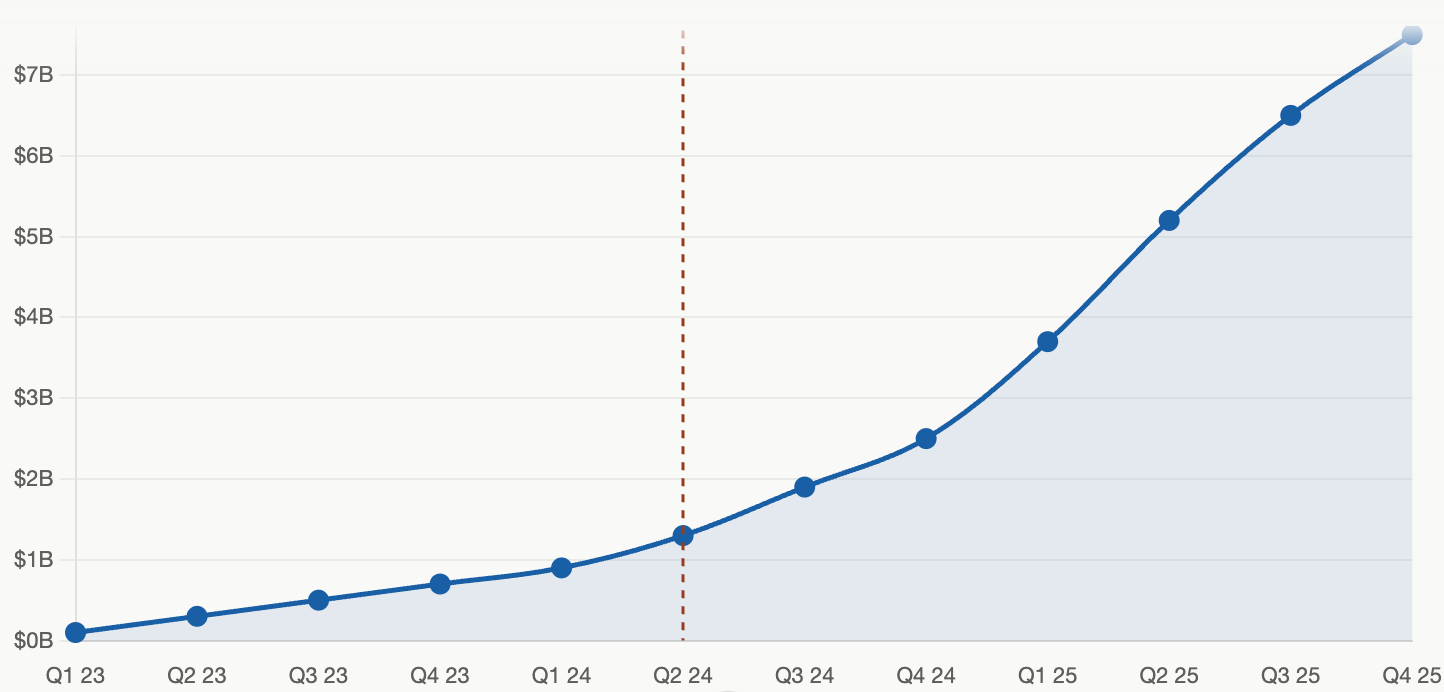
Source: app.rwa.xyz/treasuries (live figures)
What actually are tokenised treasuries?
Traditional US Treasury instruments (including T-bills, T-notes and Treasury bonds) are tokenised on the blockchain. Each token is 1 to 1 backed by government debt securely held by licensed financial institutions, enclosing one of the safest asset classes in digital form. Several interconnected infrastructure layers power the mechanics; asset managers hold actual Treasury securities or Treasury-backed money market fund shares with regulated custodians. Blockchain tokens, mostly using the Ethereum platform, represent these assets and smart contracts automate token issuance, transfer and redemption, which previously needed manual involvement. BlackRock’s BUIDL (BlackRock USD Institutional Digital Liquidity Fund), currently valued at over $2.4billion, uses a network of trusted partners and technologies to issue and custody the US Treasuries, demonstrating how blockchain technology and traditional finance interact. The fund invests in cash, US Treasury notes and repurchase agreements with BNY Mellon holding the assets and Securitise providing the blockchain infrastructure and tokenisation technology.
Investors can hold transferable digital securities (tokens) in crypto wallets, trade them on secondary markets or integrate them into decentralised finance (DeFi) protocols. Crucially, these tokens maintain the credit quality and safety of traditional Treasury securities whilst leveraging the operational advantages of blockchain technology. Yield is distributed either automatically through token rebasing or via stablecoin dividend payments. Circle’s USYC accumulates interest in the token balance whilst BlackRock’s BUIDL distributes returns separately. However, despite appearing technical, this variation affects token integration with DeFi protocols and tax treatment. Regulatory status is crucial for these devices since, unlike cryptocurrency or uncontrolled tokens, registered investment businesses or financial institutions issue tokenised treasuries under securities rules and monitoring. This regulatory compliance gives institutional investors legal assurance for large capital deployment whilst retaining safeguards for Treasury securities investors.
Institutional adoption of tokenised treasuries has accelerated dramatically (as the above chart illustrates) due to multiple complementary factors that address longstanding challenges in both traditional and digital asset markets. Traditional treasury trading delays settlement by T+1 or T+2 but since tokenised versions settle instantly, capital is not locked up during the settlement window. Efficiency means savings and better capital utilisation for billion-dollar organisations with perhaps the most immediate benefit being capital efficiency. Traditional treasury markets have ‘float periods’ - i.e. time gap between when a financial transaction is initiated and when the funds can be used. Eliminating even one settlement day may save up hundreds of millions in operating capital for multibillion-dollar portfolio managers and the capacity to rapidly switch positions 24/7 affects portfolio management tactics, allowing for more dynamic allocation decisions. Meanwhile, DeFi lending marketplaces prioritise tokenised treasuries. As protocols accept BUIDL and other tokens as high-quality collateral for borrowing, institutions may access liquidity without selling yield-generating assets. Tokenised treasuries become more useful and popular as more DeFi protocols accept them, fostering protocol integration.
Essentially, the settlement infrastructure comparison shows that blockchain-based and traditional systems differ in architecture, efficiency and operating paradigms, which affect capital markets. Traditional Treasury settlement often involves a number of intermediaries; the DTCC is the major securities repository and clearinghouse for most US securities transactions, including Treasuries. Trade matching, clearing and ultimate settlement take several days, and various institutions co-ordinate cash and securities movements throughout market hours. BlackRock’s Ethereum-based tokenisation infrastructure, developed with Securitise, enables 24/7 trading, rapid settlement and programmable compliance. Without doubt, these capabilities solve problems in traditional fixed-income markets, where settlement takes days and trading hours are limited. Blockchain-powered settlement is fundamentally different - atomic exchanges either complete immediately or do not. Smart contracts verify conditions, transfer tokens and update distributed ledger ownership records in minutes or seconds. Moreover, since markets are open 24/7, global traders may trade across time zones without business hours. Investors may effortlessly shift these assets between blockchains using “onchain shares” for quick settlement and programmable processes. Permissioned systems keep entry low and reduce regulatory risk by allowing only pre-approved businesses to participate. However, the change is complicated. The complete post-trade infrastructure stack must be upgraded, and integrating new settlement rails with decades-old systems, regulatory frameworks and operational procedures is the difficulty, not blockchain capacity.
Instant settlement fundamentally alters risk; traditional settlement windows provide mistake detection, security sourcing and cash mobilisation. Pre-funded positions and real-time risk management are needed for tight deadlines; T+0 settlement compresses counterparty risk does not eliminate it. In addition, operational procedures must handle settlement failures and exceptions in real time instead of hours or days. Certainly, these challenges are justified; settlements take minutes instead of T+2 days. Finance teams use smart contracts to automate treasury procedures in real time - treasury interoperability across chains, platforms and jurisdictions requires new custody, compliance and transparency requirements. Tokenised treasuries offer the potential to alter change financial market’s structure, accessibility and functionality, extending beyond operational efficiency. With lower requirements, individuals and smaller institutions can immediately access high-quality financing; traditional Treasury markets have high minimum investments and complicated access processes that constrain major organisations. Hence, tokenisation allows fractional ownership whereby enabling investors to own stakes of hundreds rather than hundreds of thousands of dollars, therefore extending the investment base. Rather than simply placing existing assets on the blockchain, tokenisation rebuilds financial infrastructure by using programmability, composability and interoperability as design principles. The seamless interoperability of blockchain protocols, smart contracts and dApps, which allows developers to compose new services using existing on-chain code as modular ‘Lego’ blocks. Tokenised treasuries can serve as yield-bearing assets - borrowing collateral, automated market maker liquidity and stablecoin backing. This multi-functional utility maximises capital efficiency and enables complex automated tactics that traditional markets cannot implement because of custody and operational restrictions. DeFi protocols can use tokenised treasuries, such as BUIDL, as collateral so as to increase liquidity and create synthetic assets. In addition, on-chain data analytics and smart contracts provide real-time risk assessment and dynamic pricing, saving investors and regulators time.
Moreover, international accessibility changes capital flows. Complex correspondent banking ties, foreign exchange conversions and cross-border regulatory clearances characterise traditional Treasury markets; global tokenised treasuries trade on blockchain networks, so enabling rapid cross-border settlement without middlemen. Certainly, the ramifications are significant for overseas investors seeking dollar-denominated, risk-free return without traditional banking infrastructure. In recent guidelines, the International Organization of Securities Commissions stated that tokenised money market funds are being used as reserve assets for stablecoins and as collateral for crypto transactions. After stablecoins, JPMorgan has identified tokenised money market funds as the next frontier for portability and collateral efficiency. The mass use of tokenised Treasuries by 2026 is more than simply a technological improvement. It will deepen capital market changes by making debt move faster, yield more accessible, markets programmable and interoperability important. Ultimately, the competitive landscape is changing; tokenised money market funds with better operations are challenging traditional funds and blockchain settlement must be integrated into bank treasury services or risk losing clients to more technologically advanced competition. In a future of immediate and programmable settlement, custodians, transfer agents and settlement systems face existential problems. Furthermore, these structures centralise control, raising questions about how blockchain might “capture” its open potential. The permissionless ethos of public blockchains clashes with that of permissioned ones as huge financial institutions dominate tokenised treasury markets. Most tokenised securities are institutionally controlled; hence, this discussion will determine tokenisation and whether it expands or consolidates financial power.
In under three years, tokenised treasury has moved from proof-of-concept to production-scale infrastructure. More institutions are developing solutions, more DeFi protocols are incorporating tokenised treasuries and more use cases for programmable government securities are expected to drive exponential growth. It is a fundamental shift: blockchain, smart contracts and distributed ledger technology are turning traditionally slow, intermediated assets into programmable, instantly settleable, 24/7 global instruments. Therefore, the real question this chart forces us to ask is: are we witnessing the quiet reinvention of money and markets, where liquidity, access and innovation become borderless and ‘always-on’? What took centuries of infrastructure to build in traditional finance is now being rebuilt in months onchain. The implications for yield, capital efficiency and who gets to participate in the world’s safest assets are profound.