

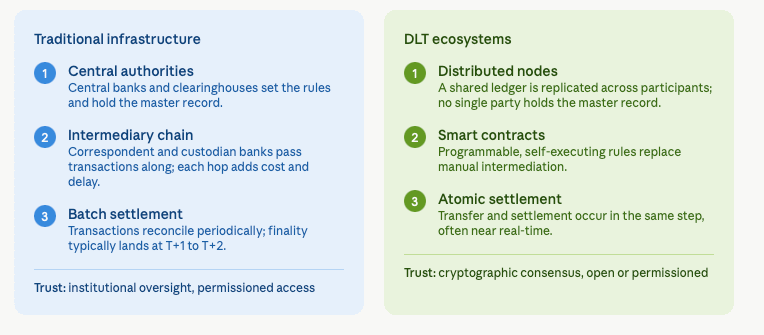
The City of London’s leadership across wholesale financial markets reflects decades of accumulated infrastructure, liquidity and legal certainty. Tokenisation, with the use of distributed ledger technology (DLT), has the potential to significant change the traditional infrastructure. As tokenisation is attracting institutional attention, the UK needs to convert its existing wholesale-market strength into a comparable position in tokenised markets. The potential for economic growth is sizeable, given the UK dominance of trillions of pounds of assets that could be tokenised. The UK’s approach will ultimately be judged on legal enforceability, operational resilience, interoperability, trust and fairness.
Tokenisation is changing how wholesale markets could operate
Wholesale financial markets, foreign exchange, interest rate derivatives, bonds, repo and securities lending, and fund units are each measured in the trillions of dollars. The new DLT-based infrastructures extend trading hours, broads the investor base, and enables programmable, near-real-time settlement enhancing today’s multi-day, cross-jurisdictional settlement chains. Realising this requires carefully staged implementation with built-in recovery arrangements: the Bank of England’s own RTGS renewal now processes close to £0.8 trillion in transactions a day, shows the scale of infrastructure required and the benefits it can deliver.
Dimension
Conventional infrastructure
DLT-native infrastructure
Securities settlement
T+1 to T+2, via central clearing
Atomic (simultaneous delivery-versus-payment)
Cross-border settlement
Typically, 1–3 days via correspondent banking
Near-instant, subject to legal and liquidity constraints
Compliance checks
Often a separate manual or batch step
Embedded in transaction logic
System architecture
Centralised infrastructure
Distributed ledger (permissioned or permissionless)
Operating hours
Defined market hours
Potentially 24/7
Error correction
Can take hours depending on process
Faster, subject to AI/human verified
The UK’s starting position is strong
Deep liquidity pools, a favourable time zone, decades of infrastructure investment and a legal framework trusted internationally. The scale of the UK’s existing wholesale-market activity includes:
· foreign exchange - approximately $4.7 trillion in daily turnover, around 38% of global activity
· interest rate derivatives - around half of global turnover
· gilts outstanding - approximately £2.5 - £2.7 trillion
· repo market - approximately £0.9 trillion, up around 50% since 2018.
HM Treasury, the Bank of England and the FCA are already working together to bring tokenisation safely into this new ecosystem. HM Treasury has appointed Chris Woolard CBE as Wholesale Digital Markets Champion, tasked with providing a report on DLT adoption and interoperability in 2027.
Tokenisation activity is growing but forecasts vary widely
Industry data aggregators suggest the value of tokenised real-world assets has grown substantially over the past few years, with private credit and tokenised money-market funds as leading categories of activity. The UK is estimated to hold a single-digit percentage share of current global tokenisation-market revenue, which when set against the UK’s £14.3 trillion of total assets under management is a great opportunity. Forecasts for the size of the global tokenisation market by 2030 vary enormously, spanning a range of $2 to $30 trillion. Given the UK’s existing dominance in the underlying asset classes now being tokenised, it is likely to scale to whichever forecast is correct.
Metric
Figure
Status / Source
UK daily FX turnover
$4.7 trillion (~38% global share)
BIS Triennial Survey 2025
UK interest rate derivatives
~50% of global turnover
BIS Triennial Survey 2025
UK gilts outstanding
~£2.5–£2.7 trillion
UK DMO Debt Management Report
UK repo outstanding
~£935 billion (+~50% since 2018)
Bank of England
Global tokenised RWA growth 2023–2025
Roughly fivefold increase
Indicative industry data aggregators; estimates vary by provider
UK 2024 tokenisation-market
Single-digit % of global share
Indicative industry estimates
UK AUM
~£14.3 trillion
Investment Association 2025
RTGS rebuild cost
£431 million
Bank of England / NAO
RTGS daily throughput
~£0.8 trillion
Bank of England
Global tokenisation market by 2030
Range: ~$2–$30 trillion
Indicative wide range across BCG, McKinsey, Standard Chartered and others
DSS participants
16 firms
FCA / Bank of England
Figures marked “indicative” are drawn from industry estimates that vary widely across providers.
Other financial centres are acting
No major financial centre has yet demonstrated a fully scaled, production-grade model for tokenised wholesale settlement. Several are running substantial parallel programmes:
· the EU’s DLT Pilot Regime, live since 2023, gave Europe early experience of DLT-based trading and settlement infrastructure.
· the ECB is separately advancing tokenised central-bank-money settlement work (Pontes), to begin linking market DLT platforms to TARGET Services (H2, 2026).
· Singapore’s Project Guardian and Hong Kong’s Fintech Supervisory Sandbox provide parallel, state-backed testing grounds in Asia.
· the US continues to develop through a mixture of federal and state rules.
Competition is intensifying as every major financial centre seeks to attract the issuance, liquidity and market infrastructure that will underpin the next generation of tokenised wholesale financial markets. The UK starts from a position of genuine structural strength. It already dominates many of the underlying asset classes now being digitised, including foreign exchange, interest rate derivatives, international capital markets and asset management. Yet this advantage should not be regarded as permanent. Jurisdictions across Europe, Asia, the Middle East and North America are investing heavily in comparable tokenisation infrastructure whilst seeking to influence the international standards, legal frameworks and interoperability protocols that will govern future markets. Success is therefore likely to depend less on being first than on delivering a credible, phased strategy that combines legal certainty, operational resilience, trusted regulation and scalable market infrastructure. The Bank of England and the Financial Conduct Authority have established an important foundation through initiatives such as the Digital Securities Sandbox and synchronised settlement programmes. The challenge now is to convert the UK’s existing leadership in wholesale finance into long-term leadership in programmable, tokenised and AI-enabled capital markets before the current window of opportunity narrows.
Markets tend to accommodate regulatory uncertainty more easily than implementation uncertainty. A credible, phased delivery path even one that takes until 2028 to reach live central-bank-money settlement is likely to encourage more investment than an ambitious date that is later deferred. The priority for the year ahead is less about the size of the eventual market than about whether the UK can demonstrate, through the DSS, the DIGIT pilot and the Bank’s synchronisation work, that tokenised settlement can be made to work safely and at scale. The original Big Bang transformed London’s financial markets by removing barriers to human capital. Tokenisation could become Britain’s next Big Bang by removing barriers to machine capital. As autonomous AI agents increasingly allocate capital, manage liquidity and execute transactions, they will optimise for trusted law, trusted money, trusted regulation and trusted market infrastructure. The jurisdictions that combine those attributes first are unlikely merely to attract tokenised assets - they will attract the trillions of pounds of capital that flow through them. The race is no longer about blockchain. It is about becoming the world’s most trusted financial operating system for the AI economy.