
When digital dollars pay different rates: is Gresham’s Law returning? Written by David Parsons and Jonny Fry*, London Digital Escrow

Part 4 of 8: “The case for the singleness of money”
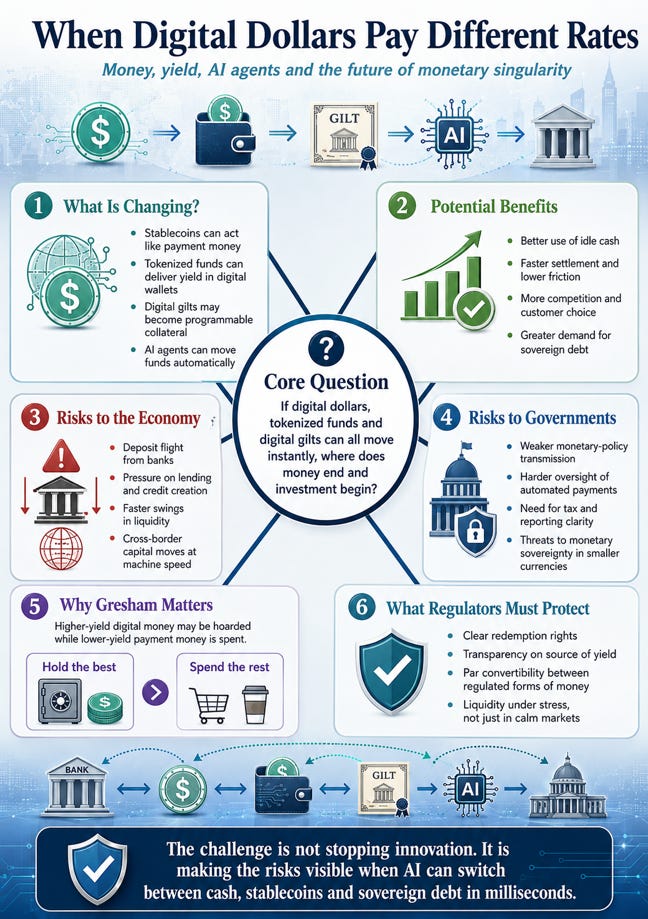
Digital finance is now testing that principle in a new form. The United States’ GENIUS Act, formally the Guiding and Establishing National Innovation for US Stablecoins Act, created a federal framework for payment stablecoins. It requires permitted issuers to maintain reserves at least one-for-one in cash, short-dated Treasuries, overnight repurchase agreements and other highly liquid assets. Crucially, the law prevents an issuer from paying interest or yield merely because someone holds, uses or retains its stablecoin. That restriction is not an accidental concession to banks - it preserves the distinction between money and an investment. A payment stablecoin promises redeemability at a fixed monetary value. A bond, money-market fund or deposit promises a return because the holder is accepting some combination of liquidity, duration, credit or institutional risk. Once a payment instrument begins paying different rates, instruments that appear identical at one dollar may acquire very different economic characteristics.
When digital money meets AI innovation
Source: London Digital Escrow
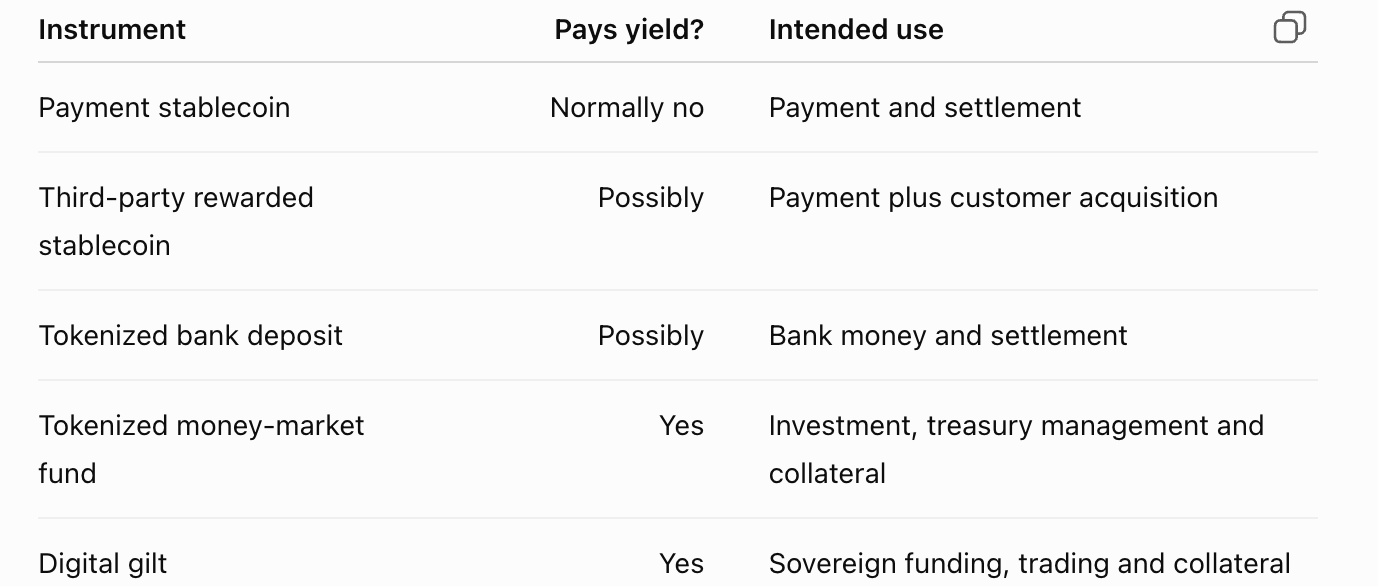
The debate is already moving beyond issuers. The Senate’s proposed CLARITY legislation would restrict rewards on idle stablecoin balances whilst potentially allowing incentives linked to transactions. That compromise reveals the central policy problem: a stablecoin issuer may be prohibited from paying yield, yet an exchange, wallet provider or affiliated platform could still reward customers. The legal source of the payment changes but the customer may experience the product as an interest-bearing digital dollar. That distinction matters because software can combine separate products into one seamless economic experience for the customer. This is where Gresham’s Law becomes relevant, although not in its classical form. Gresham’s Law describes what happens when two forms of legally equivalent money circulate at the same official value despite different underlying worth. People spend the inferior money and retain the superior money. Competing stablecoins are not necessarily legal tender and can trade at different prices, so the comparison is imperfect. Nevertheless, the behaviour may be ‘Gresham-like’: households, companies and AI agents could retain the token offering the highest return and spend the token offering none. Yet this is also what corporate treasurers already do - they hold surplus cash in deposits, Treasury bills and money-market funds, then convert those assets into transactional money when invoices fall due. Historically, bonds did not become everyday currency because settlement was slow, ownership records were fragmented, accrued interest complicated valuation and selling an asset before making a payment created cost and delay.
Comparision between five tokenised instruments
Source: London Digital Escrow
Tokenisation is removing those frictions. BlackRock’s BUIDL fund gives qualified investors a blockchain-recorded interest in a portfolio of cash, Treasury bills and repurchase agreements, whilst Franklin Templeton has used blockchain infrastructure to record ownership in a government money-market fund. These are securities, not stablecoins, but they demonstrate that a yield-bearing asset can now sit inside a digital wallet, transfer across blockchain infrastructure and potentially be exchanged for payment money almost instantly. The risks are equally real - in March 2023, USDC temporarily lost its dollar peg after Circle disclosed that $3.3 billion of its reserves remained at Silicon Valley Bank. USDC was substantially reserved, yet uncertainty about one banking partner caused holders to sell. The episode demonstrated that assets could look identical in calm markets but behave differently when confidence is tested. The question, therefore, is not whether yield-bearing stablecoins have already destroyed monetary singularity - they have not. The more important question is whether digital infrastructure is erasing the boundary between money and investments. If every wallet can move instantly between payment tokens and tokenised securities, regulators may discover that prohibiting yield on stablecoins does not prevent digital money from becoming yield sensitive. It merely moves the yield one click away.
The next stage of this debate will not be driven only by consumers choosing between digital wallets - it will be driven by autonomous software. AI agents will increasingly compare prices, negotiate contracts, manage working capital and initiate payments. Imagine a company that holds £100 million. Today, some money remains in bank deposits for immediate payments whilst excess liquidity is placed in money-market funds. Tomorrow, an AI treasury agent could keep all idle capital in a tokenised fund, monitor liabilities continuously and convert only the exact amount required into a payment stablecoin or tokenised deposit seconds before settlement. In that world, the higher-yielding instrument is still being retained, and the non-yielding instrument is still being spent. But money’s velocity may not collapse. Automated conversion could increase transaction frequency whilst reducing the amount of capital sitting unproductively in payment accounts. The relevant question is no longer simply how quickly a stablecoin moves: policymakers must measure the velocity of the entire chain linking deposits, stablecoins, tokenised funds, collateral and settlement assets.
This also complicates claims that stablecoins will inevitably destroy bank lending. Deposits are important sources of bank funding (particularly for smaller banks) and large movements into stablecoins could raise funding costs or reduce lending capacity. However, the final impact depends on where the reserves are invested and how banks respond. They may offer higher deposit rates, issue tokenised deposits or obtain wholesale funding. Federal Reserve Governor, Stephen Miran, has argued that stablecoin growth could increase demand for Treasury securities and potentially add to the supply of loanable funds. He also acknowledged that converting existing domestic bank deposits into stablecoins could disintermediate banks and affect monetary-policy transmission. Stablecoins could therefore strengthen dollar demand whilst weakening particular institutions, and both outcomes can occur simultaneously.
The UK now faces the same strategic question from another direction. The government has announced that it intends to issue its first digital sovereign bond by early 2027. A digital gilt could improve issuance, settlement, collateral mobility and lifecycle management. It could also allow gilts to interact directly with programmable financial infrastructure. But a digital gilt is not automatically digital money. Its market price can rise or fall, it pays a coupon and its value depends on maturity and prevailing interest rates. The commercial breakthrough occurs when the digital gilt becomes usable as collateral or can be exchanged automatically into settlement money. An AI agent could hold a short-dated digital gilt, pledge it within a smart contract, draw tokenised liquidity and complete a transaction without selling the asset through today’s sequence of brokers, custodians and settlement systems. Economically, the gilt begins to perform some functions of money whilst legally remaining a security - and that possibility should shape regulation. Authorities must preserve clear redemption rights, disclose the source of every return and ensure that users know whether they hold central bank money, a bank liability, a stablecoin claim or a security. Interoperability matters because one form of regulated money should exchange for another at par without hidden discounts. Reserves must remain genuinely liquid under stress, not merely appear liquid during normal markets. Tax and accounting rules must also avoid turning every automated conversion into an administrative obstacle.
Ultimately, governments should resist two simplistic conclusions: the first is that all yield-bearing digital instruments threaten monetary stability and should be prohibited; the second is that technology can make every asset function as money without changing its risks. Yield can improve competition and reward savers, but it is never free. Someone is taking duration, liquidity, credit, operational or market risk to generate it. Newton’s achievement was to restore confidence by aligning technology, enforcement and public acceptance. The digital age requires the same alignment, but governments no longer possess an exclusive technological advantage. Banks, asset managers, stablecoin issuers and AI platforms can now create instruments that move faster than regulation and appear interchangeable on a screen. The future singleness of money will not be protected by banning innovation - it will depend on making differences visible at the moment of payment. When an AI agent can move between cash, stablecoins and sovereign debt in milliseconds, then the decisive question will not be which asset is called money: it will be which risks society has silently allowed machines to treat as equivalent.
Andrew Bailey’s warnings about monetary fragmentation are not theoretical. The GENIUS Act modification may prove them in real-time.
Series Overview
Andrew Bailey, Governor of the Bank of England, has warned repeatedly about the dangers of monetary fragmentation. This series explores whether his warnings came too late.
This is Part 4 of an 8-part series exploring “The case for the singleness of money”. Each week, a new article will build on the previous one, exploring why monetary singularity is essential, why it is being destroyed and what comes next.
Coming in this series:
Part 5: Why yield-bearing money destroys the banking system
Part 6: How tax payments became the ultimate monetary weapon
Part 7: The agentic USD threat to sterling sovereignty
Part 8: The twisted ending: why singularity is dead
*Jonny Fry is a director of London Digital Escrow